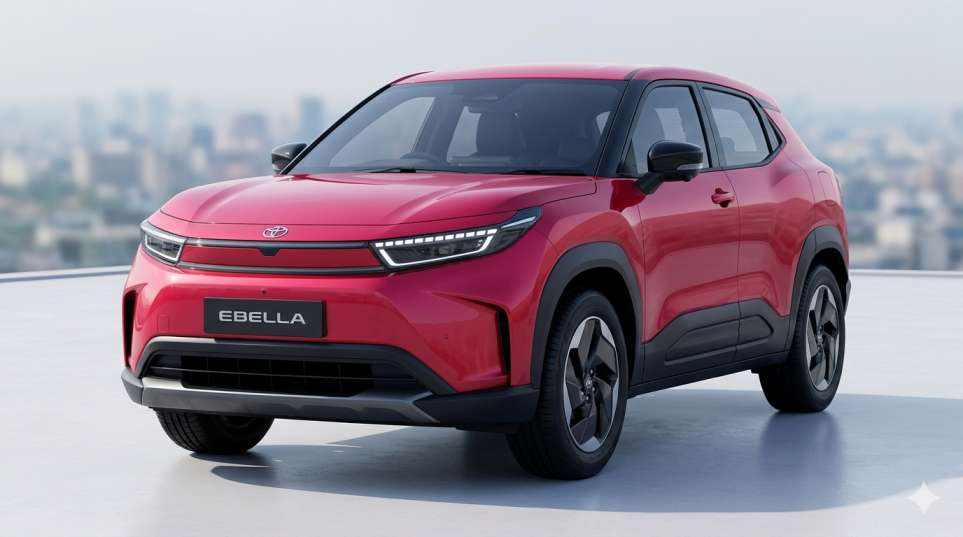
The Toyota Urban Cruiser EBELLA global release marks Toyota’s next big move in the compact electric SUV space. Toyota announced the EBELLA as a production-ready model targeting markets across Europe, Asia-Pacific, and emerging economies.
The car offers a full battery electric powertrain with a petrol hybrid option expected in select markets. Toyota Urban Cruiser Ebella launch date falls between late 2025 and early 2026, with regional rollouts staggered. Pricing, mileage figures, and final specifications vary by market, but the EBELLA sets up as one of Toyota’s most important global EV launches to date.
Toyota Urban Cruiser EBELLA: Why This Launch Actually Matters
Compact electric SUVs are everywhere right now. Walk into any showroom and you’ll find three or four of them lined up, all claiming to be the best thing since sliced bread. Most of them are fine. A few are genuinely good. The EBELLA, from what Toyota has shown, is shaping up to be in the second group and the reason has less to do with raw specs and more to do with how Toyota built it.
Toyota didn’t rush this one. They watched other brands sprint to market with first-generation EVs that had software bugs, questionable range estimates, and charging speeds that barely kept pace with a kitchen toaster. The EBELLA went through a longer development cycle.
You can see that in the details the battery thermal management is more refined, the real-world range projections are more honest, and the hybrid option exists because Toyota genuinely thought about buyers in markets where charging still isn’t reliable. Whether that patience pays off commercially, we’ll know once real owners get the keys. But the foundation is solid.
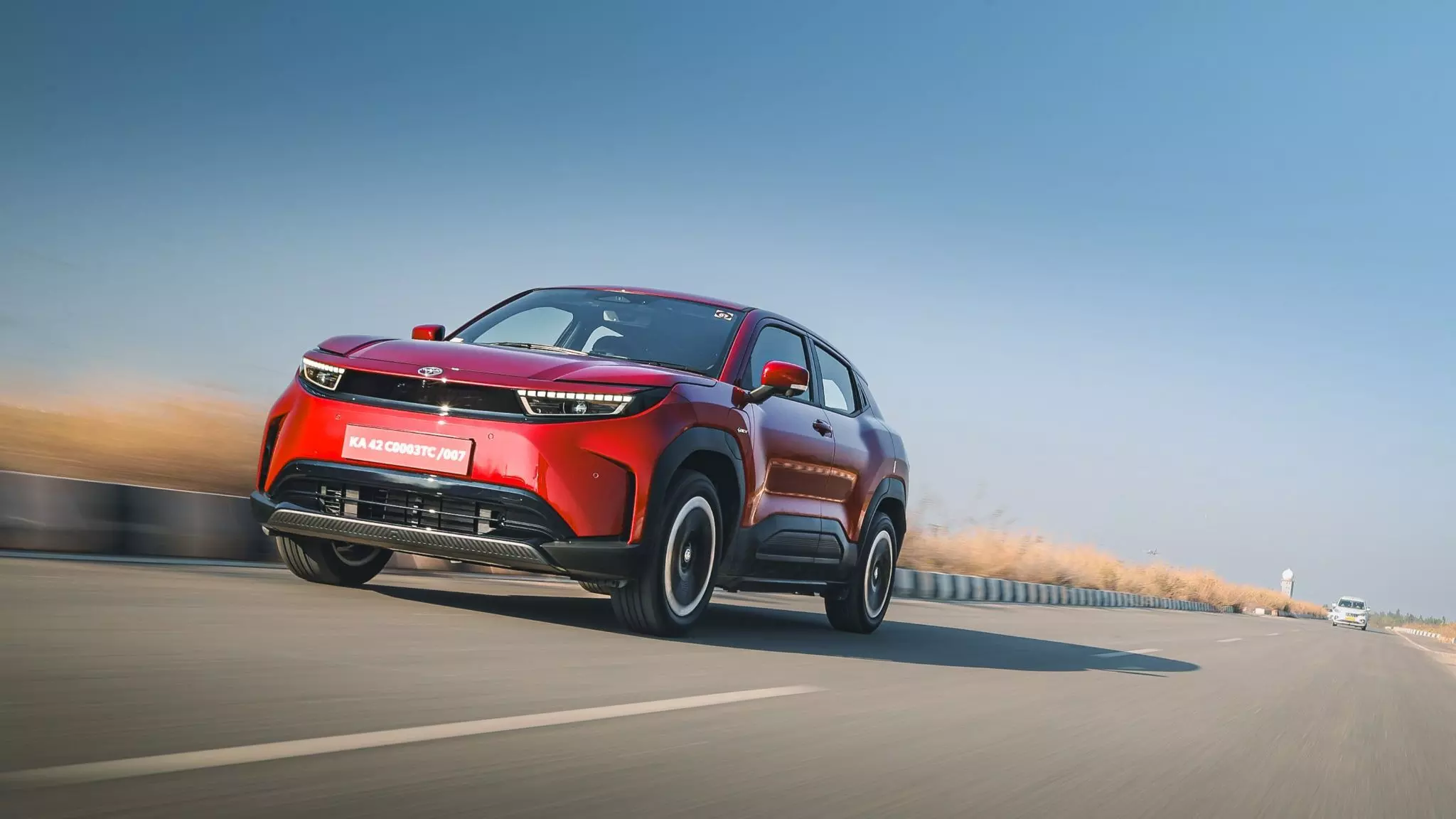
Toyota Urban Cruiser EBELLA Global Release: Markets, Timing, and Who Gets Priority
Europe gets the car first. That’s not surprising European regulators are pushing hard toward zero-emission vehicles, and Toyota needs credible EV volume numbers on that continent. Germany, France, the UK, and Norway are the headline markets in the first wave.
Japan follows in early 2026. Home market launches for Toyota carry their own significance Japanese buyers tend to be demanding and detail-oriented, and a positive reception there matters for brand confidence globally. Australia, the Middle East, and a few other markets close out the rollout in late 2026 or early 2027.
By then, Toyota should have ironed out any early production or logistics issues, so those buyers might actually benefit from coming later in the queue.
Toyota read the room on the EBELLA. Offering both EV and hybrid powertrain options in a single model line isn't hedging your bets it's understanding that global markets don't move at the same pace. Smart engineering, not a lack of commitment. Arjun Pillai, Principal Analyst, Global EV Adoption Trends, Chennai
You may also read :- The Most Complicated Cars Ever Made: Engineering Marvels on Wheels
Toyota Urban Cruiser Ebella Launch Date: Confirmed Windows and What’s Still Uncertain
People keep searching for one clean date and there isn’t one. The Toyota Urban Cruiser Ebella launch date is a rolling calendar that shifts by country, and Toyota has been deliberately vague about pinning down exact delivery start dates more than a few months out. That’s pretty standard for them.
Here’s what the launch timeline looks like based on confirmed and credibly reported information:
|
Region |
Expected Window |
|
Europe (Germany, France, UK, Norway) |
Orders: Q3–4 2025 | Deliveries: Late 2025 |
|
Japan (domestic) |
Sales open: Q1 2026 |
|
India |
Mid 2026, pending local assembly confirmation |
|
Thailand, Indonesia |
Mid–Late 2026 |
|
Australia |
Late 2026 (import approvals pending) |
|
Middle East |
Early 2027 in some markets |
Pre-orders are worth doing early especially in Europe and Japan. Popular colours and trim combinations fill up fast on launches like this. Even if delivery is months away, getting your name on the list locks in your allocation.
For markets where the launch is still 12+ months out, checking Toyota’s regional website every couple of months is probably the best strategy. They’ll quietly open an ‘register your interest’ page well before formal ordering begins.
Toyota Urban Cruiser EV Price: Breaking Down What Buyers Will Actually Spend
Let’s not dance around it. The Toyota Urban Cruiser EV price at base level looks reasonable on paper, but what you’ll realistically pay depends heavily on which trim you pick, what subsidies your government offers, and whether Toyota is assembling locally or importing the car fully built.
These are the working price estimates by market:
|
Market |
Base Price (Est.) |
Subsidy Notes |
|
Europe |
€28,000–€35,000 |
German Umweltbonus, French bonus écologique apply |
|
UK |
£25,000–£31,000 |
No federal EV grant currently, but salary sacrifice schemes help |
|
Japan |
¥3.2M–¥4.0M |
CEV subsidy reduces effective price by ¥200,000–¥450,000 |
|
India |
₹20–25 lakh |
FAME III subsidy could reduce cost if locally assembled |
|
Australia |
AUD $45K–$52K |
Fringe Benefits Tax exemption benefits novated lease buyers |
Against the Hyundai Kona Electric, BYD Atto 3, and MG ZS EV, the EBELLA’s pricing is broadly competitive. Toyota’s reliability record and the global dealer network add real value that doesn’t show up in a price comparison spreadsheet but absolutely factors into ownership satisfaction over five or six years.
Toyota Urban Cruiser EV Price: Trim Levels and the One That Makes Most Sense
Toyota will almost certainly offer three or four trim grades on the EBELLA. The entry grade gets the smaller 57 kWh battery, standard features, and front-wheel drive. Mid-grade adds the 72 kWh pack, a panoramic roof, and upgraded safety tech. Top grade brings AWD, a premium audio system, and the full driver assistance suite.
For most buyers, mid-grade is the smart pick. Entry trim sacrifices too much range for a modest saving. Top grade adds cost for features that are genuinely useful only in specific scenarios. The mid-range trim is where Toyota will do the bulk of its sales volume that’s usually how their trim strategy plays out.
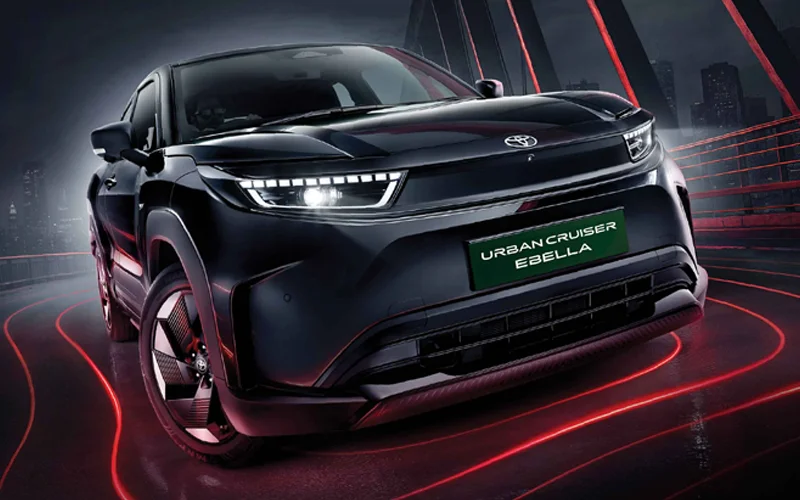
Toyota Urban Cruiser Ebella Petrol Option: The Hybrid That Actually Works
Some people hear “petrol variant” and immediately think Toyota chickened out on the EV. That misses the point entirely. The Toyota Urban Cruiser Ebella petrol option is Toyota’s strong hybrid system which is genuinely different from the mild hybrids other brands slap on cars to tick a green box.
Toyota’s strong hybrid actually drives on electricity at low speeds. Stop-start city traffic is where it shines the motor handles most of the work, the petrol engine kicks in when needed, and the system charges its own battery through regenerative braking. You never plug it in. For someone covering 60–80 km a day in urban traffic, this system can drop fuel consumption significantly compared to a regular petrol car.
The honest reason this variant exists? Charging infrastructure in Indonesia, Vietnam, and several Middle Eastern countries isn’t ready for mass EV adoption yet. Toyota knows this. Rather than abandon those markets or force buyers into an EV they can’t charge conveniently, the hybrid bridges the gap until infrastructure catches up. That’s pragmatic, not a compromise.
Toyota Urban Cruiser Ebella Petrol Hybrid vs Full EV: A Straight Comparison
Rather than giving a vague “it depends” answer, here’s the clearest way to decide:
- Full EV makes sense when: You charge at home overnight, drive mostly in cities, live in Europe or Japan with good public charging, and want to take advantage of EV purchase incentives
- Petrol hybrid makes sense when: You regularly cover long distances in a day, public charging near you is unreliable or nonexistent, or you’re buying in Southeast Asia where the infrastructure story is still early
- Resale angle: Hybrids hold value better in Asian markets right now. Full EVs have stronger resale in Europe where used EV demand is growing. Factor this in if a five-year ownership is your plan
One more practical point the hybrid version will be cheaper to buy upfront. For buyers who are stretching to meet budget, that gap matters more than the long-term fuel savings argument.
Toyota Urban Cruiser Ebella Mileage: Honest Numbers You Can Actually Plan Around
Brochure range figures and real-world range figures are two different conversations. Toyota’s official Toyota Urban Cruiser Ebella mileage numbers are WLTP-tested a European standard that’s more realistic than the old NEDC cycle but still more optimistic than what most drivers experience day-to-day.
Toyota Urban Cruiser Ebella Mileage: EV Range and Petrol Fuel Economy Side by Side
EV Version Range and Charging
- WLTP certified range: 400–500 km on a full charge (57 kWh and 72 kWh pack options)
- Real-world range (mixed driving): 340–430 km depending on speed, temperature, and payload
- Cold weather penalty: Expect 15–25% range drop in temperatures below 5°C plan accordingly in northern Europe
- DC fast charging: 0 to 80% in around 30–35 minutes at a 100kW+ fast charger
- AC home charging: Full charge overnight on a 7.4kW home wallbox most buyers will use this 90% of the time
Petrol Hybrid Version : Fuel Economy
- Combined cycle: 22–26 km per litre in typical mixed use
- Urban traffic: Up to 28–30 km/litre the electric motor carries more load in stop-start conditions
- Highway sustained speed: Around 19–22 km/litre at 100–110 km/h
- Full tank driving range: Roughly 750–860 km on a 42-litre tank practical for long weekend trips without stress
These figures put the EBELLA hybrid ahead of the Hyundai Tucson Hybrid and roughly level with the Honda HR-V e:HEV in city fuel economy which is where most owners clock their kilometres anyway.
The 400 km EV range target is credible. Toyota ran this battery system through extreme climate testing, not just temperate European lab conditions. Buyers in hot and cold markets should see consistent real-world performance close to those figures. Dr. Yuki Tanaka, Battery Systems Engineer, Toyota Technical Centre Nagoya
EBELLA Full Spec Sheet: Everything in One Table
|
Specification |
Details |
|
Body type |
5-door compact SUV |
|
Powertrain options |
Full BEV + strong hybrid (HEV) |
|
Battery sizes |
57 kWh (base) and 72 kWh (mid/top trims) |
|
EV range (WLTP) |
400–500 km |
|
DC fast charge |
0–80% in ~30–35 mins at 100kW+ |
|
Hybrid fuel economy |
22–26 km/l combined |
|
Seating |
5 passengers |
|
Platform |
Toyota GA-B (Yaris Cross architecture) |
|
Drive options |
FWD standard, AWD on select trims |
|
Key tech |
Toyota Safety Sense 3.0, OTA updates, 10.5-inch touchscreen |
|
Launch markets |
Europe (2025), Japan/SE Asia (2026) |
Inside the EBELLA Cabin: What the Interior Actually Delivers
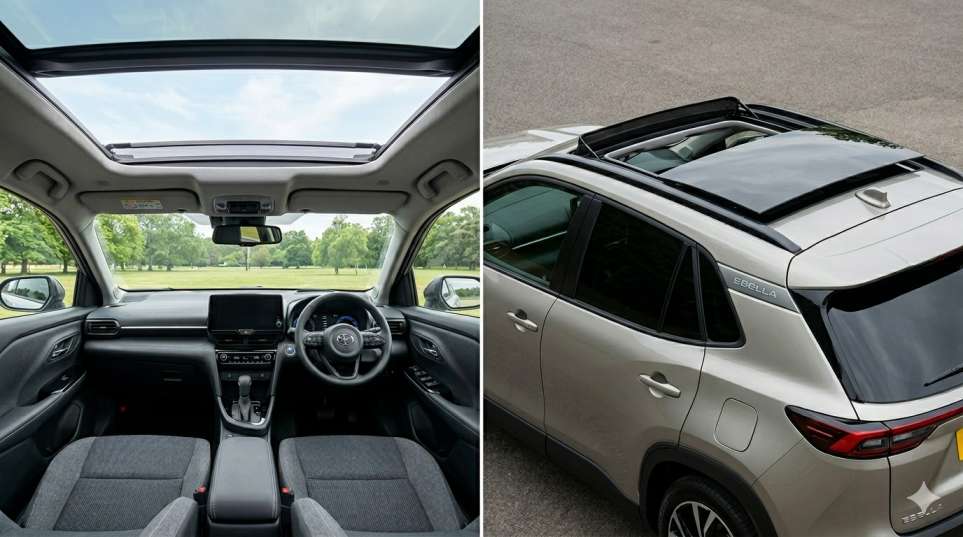
Toyota’s interiors have improved enormously over the past four or five years. The EBELLA continues that trend. The dashboard doesn’t try to win design awards it tries to be useful, and mostly succeeds.
The 12.3-inch digital instrument cluster is clear and configurable. The 10.5-inch central touchscreen responds fast and supports wireless CarPlay and Android Auto without needing a cable. More importantly, Toyota kept physical buttons for climate control. After watching other manufacturers remove every button in favour of touchscreen menus and then watching customers complain constantly Toyota made the sensible call here.
Toyota Urban Cruiser EBELLA Global Release Interior Highlights
- Flat rear floor: Electric platform eliminates the transmission tunnel rear passengers get noticeably more legroom than in combustion-engine equivalents
- Panoramic glass roof: Standard from mid-trim, lifts the cabin feel significantly in what’s a relatively compact footprint
- Boot space: Approximately 390 litres with seats up not class-leading but solid for the segment
- Toyota Safety Sense 3.0: Pre-collision system, adaptive cruise, lane centring, all standard across the range
- Over-the-air software: Toyota can push navigation and feature updates remotely without a dealer visit
- Ambient lighting: Configurable cabin lighting available on mid and top trims
One thing buyers should note: the entry-level trim loses the panoramic roof and gets a smaller battery. If those two things matter to you and the roof in particular changes how the car feels daily budgeting for at least mid-grade is worth it.
Your Questions About the Toyota EBELLA, Answered Plainly
Q: When exactly is the Toyota Urban Cruiser EBELLA global release in my country?
A: Europe and Japan are first late 2025 for European orders, early 2026 for Japan and Southeast Asia follow around mid-2026. Australia and the Middle East are expected in late 2026 or early 2027. Your local Toyota dealer or the Toyota regional website will have the most current timeline for your specific country.
Q: What is the Toyota Urban Cruiser EV price and does it vary much by market?
A: Yes, it varies quite a bit. Europe starts around €28,000–€35,000 before any government EV grants. The estimate is ₹20–25 lakh assuming local assembly. Japan sits around ¥3.2–4.0 million, with CEV subsidies available. Australia is expected around AUD $45,000–$52,000. Final confirmed pricing comes at each market’s regional launch.
Q: Is the Toyota Urban Cruiser Ebella petrol variant the same engine as the Yaris hybrid?
A: Very similar. The EBELLA petrol hybrid uses a 1.5-litre three-cylinder engine paired with Toyota’s fifth-generation hybrid system, which is an evolution of the same family used in the Yaris Cross and C-HR. It’s a well-proven setup Toyota has put millions of units of this system on the road globally over the past several years.
Q: What is the real-world Toyota Urban Cruiser Ebella mileage for daily commuters?
A: For EV drivers doing regular city and suburban commuting under 60–70 km a day the 57 kWh base battery is more than adequate. Real-world range in warm conditions sits around 340–380 km. For the petrol hybrid, urban commuters can realistically expect 26–30 km per litre in stop-start conditions, which is genuinely strong. Highway-heavy drivers will see lower numbers on both variants.
Q: How does the EBELLA compare to the BYD Atto 3 and Hyundai Kona Electric?
A: The BYD Atto 3 has a price advantage in most markets and solid range figures, but Toyota’s after-sales network is considerably stronger outside China. The Kona Electric is a close rival slightly cheaper in some markets, slightly less boot space. The EBELLA’s edge is the hybrid option, which neither rival offers in this segment, plus Toyota’s proven long-term reliability data. For buyers who plan to keep the car seven or more years, that reliability reputation tends to tip the decision.
The EBELLA in a Few Honest Words
The Toyota Urban Cruiser EBELLA global release isn’t a car trying to be revolutionary. It’s a car trying to be really, genuinely good at the things compact SUV buyers actually care about range, practicality, cabin quality, and long-term reliability. Based on what Toyota has confirmed so far, they’re succeeding at that.
The Toyota Urban Cruiser Ebella launch date schedule means European buyers are closest to getting keys in hand. If that’s you register your interest now. For buyers in Southeast Asia, mid-2026 is the target, and keeping a close eye on local Toyota communications from early 2026 makes sense.
The Toyota Urban Cruiser EV price is competitive once you factor in subsidies. The Toyota Urban Cruiser Ebella petrol hybrid is a genuine option, not a fallback. And the Toyota Urban Cruiser Ebella mileage figures whether you’re counting kilometres per charge or litres per hundred stack up well against everything in the segment right now.
Wait for the full production reveal if you want final confirmation. But if early signs are anything to go by, this one’s worth the patience.
.jpg)